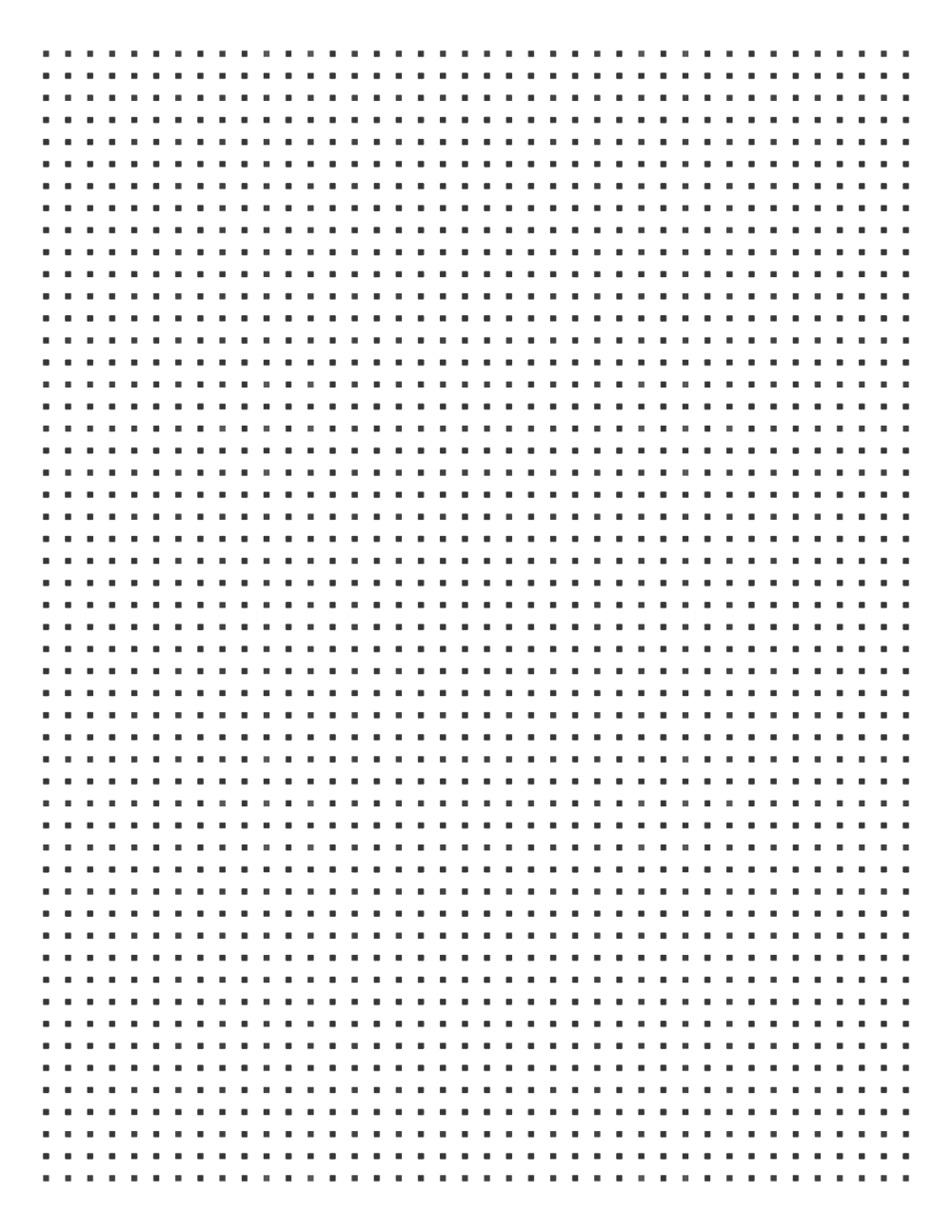
Preview of the 5 mm dot spacing, A4 file
Paper
Dot Grid Paper
5 mm and 1/4 inch dotted paper for journals, sketches and layouts.
- Price
- Free
- Format
- Size
- 1 page each, portrait
Download
- PDF5 mm dot spacing, A4100 KBDownload
- PDF5 mm dot spacing, US Letter98 KBDownload
- PDF1/4 inch dot spacing, A457 KBDownload
- PDF1/4 inch dot spacing, US Letter54 KBDownload
Free for home, classroom and office use. No sign-up.
About this printable
Dotted paper gives you alignment points without filling the page with lines, which makes it popular for bullet journals, hand lettering, UI sketches and diagrams. The dots are small gray vector circles, about 0.4 mm across, so they stay crisp and print evenly. There is no logo, website address or footer on the page.
5 mm spacing matches most dotted notebooks sold in stores. 1/4 inch spacing (6.35 mm) gives four dots per inch for layouts measured in inches, so the spacing is about 27% wider.
What is on each sheet
- 5 mm, A4: 38 by 56 dots, a grid 185 mm wide and 275 mm tall
- 5 mm, US Letter: 40 by 52 dots, a grid 195 mm wide and 255 mm tall
- 1/4 inch, US Letter: 31 by 41 dots, exactly 7.5 by 10 inches with a half-inch border on every side
- 1/4 inch, A4: 30 by 44 dots, 7.25 by 10.75 inches
Who uses dot grid paper
Bullet journal fans use it because they can draw any layout they like: a monthly log one week, a reading list the next. Hand letterers use the dots as invisible guidelines for letter height and slant. Designers and developers sketch phone and web screens on it, since the dots keep boxes aligned without the visual noise of a full grid. Teachers use it for geometry work such as drawing shapes, counting area and plotting reflections, and tabletop gamers use it for quick dungeon and town maps.
Compared with graph paper, the page looks almost blank once you write on it, so finished pages read cleanly and photograph well. Compared with lined paper, you can switch between writing, tables and drawings on the same sheet.
Layouts that fit the 5 mm grid
Counting in dots makes layouts fast and tidy. Think in gaps (the space between two dots): the A4 sheet is 37 gaps wide and 55 gaps tall, and the Letter sheet is 39 gaps wide and 51 gaps tall.
- Habit tracker: give each day one column. On A4, 6 gaps for habit names plus 31 day columns use the full width exactly. On Letter, use 8 gaps for names.
- Month calendar: make each day box 5 gaps square. Seven columns take 35 gaps, which fits on both sizes, and six rows take 30 gaps, leaving room for notes below.
- Weekly spread: split the page into two columns with a one-gap gutter. On A4 that is 18 + 1 + 18 gaps.
- Writing lines: write on every second row of dots for 10 mm lines, which feel roomy, or on every row for very small handwriting.
- Hand lettering: use one gap for the x-height and one more for ascenders and descenders, then move up to two gaps when you practice larger letters.
5 mm or 1/4 inch?
Choose 5 mm if you want the same spacing as a store-bought dotted journal, if you write fairly small, or if you plan to slip printed pages into an existing notebook system. Choose 1/4 inch if your handwriting is large, if the pages are for children, or if you are drawing to an inch scale. A common drafting scale is 1/4 inch to 1 foot, so on the Letter sheet each gap can stand for one foot and the whole grid covers a 30 by 40 foot area.
Common mistakes
- Printing with Fit to page. The dots shrink by a few percent, which is enough to drift out of line with a notebook you already use.
- Leaving toner saver or draft mode on. Small dots are the first thing those modes drop, and some may disappear.
- Using markers or fountain pens on thin copy paper. Ink bleeds through 75 to 80 g/m² paper; heavier paper solves it.
- Drawing guidelines too dark. Light pencil lines between the dots can be erased once the ink is dry; heavy ones leave grooves.
How to print it
- 1Print at Actual size or 100% if the spacing matters, for example when matching a notebook you already use.
- 2Measure several gaps at once: ten 5 mm gaps should be 50 mm, and four 1/4 inch gaps one inch.
- 3Heavier paper (90 to 120 g/m², about 24 to 32 lb) reduces show-through if you write with fountain pens or markers.
- 4Choose the file that matches your paper. The A4 file on Letter paper loses the bottom rows, and the Letter file on A4 leaves an uneven border.
Questions
Is 5 mm the same as bullet journal dot grid?
Yes, most dotted journals use 5 mm between dots.
How many dots are on a page?
The 5 mm A4 sheet has 2,128 dots (38 by 56) and the 5 mm Letter sheet has 2,080 (40 by 52). The 1/4 inch sheets have 1,271 on Letter and 1,320 on A4.
Can I print it double-sided?
Yes, but print a test sheet first and hold it up to the light. Small feed differences can make the two sides slightly offset.
Can I make a planner from it?
Print several copies, draw your layout on one, then scan or photograph it and use Merge PDF to combine pages into a booklet.