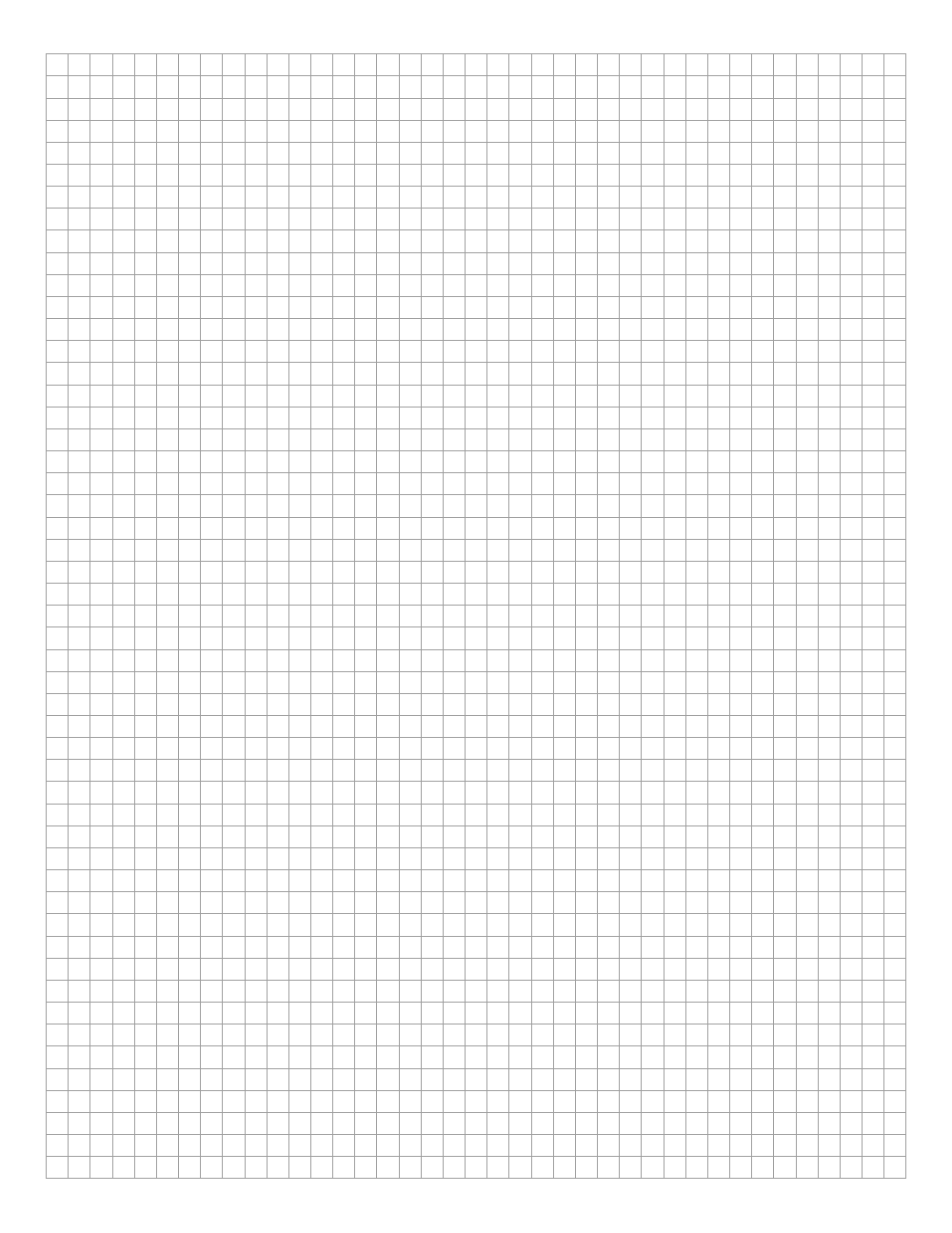
Preview of the 5 mm squares, A4 file
Paper
Graph Paper
5 mm, 1 cm and 1/4 inch square grids, plus a light low-ink version.
- Price
- Free
- Format
- Size
- 1 page each, portrait
Download
- PDF5 mm squares, A42 KBDownload
- PDF5 mm squares, US Letter2 KBDownload
- PDF1 cm squares, A41 KBDownload
- PDF1 cm squares, US Letter1 KBDownload
- PDF1/4 inch squares, A41 KBDownload
- PDF1/4 inch squares, US Letter1 KBDownload
- PDF5 mm squares, low ink, A42 KBDownload
- PDF5 mm squares, low ink, US Letter2 KBDownload
Free for home, classroom and office use. No sign-up.
About this printable
Square-grid paper for math, plotting, floor plans, pixel art and craft layouts. Every file is a single vector page, so the grid stays sharp and measures correctly when printed at actual size. Nothing but the grid is printed: no logo, website address or footer.
5 mm gives 20 squares across 10 cm and is the usual grid for school math. 1 cm squares are larger, for early math and diagrams with labels inside the cells. 1/4 inch gives four squares per inch for patterns and plans written in inches. The low-ink version has thinner, lighter lines that sit behind your pencil marks.
Grid sizes and square counts
Every line on these sheets has the same weight; there are no heavier lines every centimeter or inch. If you want major lines, count them off and go over every fifth or tenth line with a pencil and ruler.
- 5 mm, A4: 37 by 55 squares (185 by 275 mm)
- 5 mm, US Letter: 39 by 51 squares (195 by 255 mm)
- 1 cm, A4: 18 by 27 squares (180 by 270 mm)
- 1 cm, US Letter: 19 by 25 squares (190 by 250 mm)
- 1/4 inch, US Letter: 30 by 40 squares (7.5 by 10 inches)
- 1/4 inch, A4: 29 by 43 squares (7.25 by 10.75 inches)
Scale drawings and floor plans
Graph paper is the quickest way to sketch a room, garden or deck to scale. Measure the space first, then pick a scale that makes the longest side fit on the sheet. On the 1/4 inch Letter sheet, the common drafting scale of 1/4 inch to 1 foot makes each square one foot, so the grid holds a space up to 30 by 40 feet. In metric, the 1 cm sheet at 1:100 makes each square one meter, and the 5 mm sheet at 1:100 makes each square half a meter, enough for an 18.5 by 27.5 meter plot on A4.
Draw walls first, then doors (a quarter circle shows which way they swing) and windows. For furniture, draw each piece to the same scale on a second sheet, cut it out and move it around the plan before you move anything heavy. Write the scale in a corner of the page so the drawing still makes sense a year from now.
Math and science
For graphing functions, draw the axes on grid lines, decide how many squares equal one unit, and label both axes before plotting. Two squares per unit on the 5 mm grid gives a readable graph that still fits values from about minus 9 to plus 9 across an A4 page. For science lab data, spread the axis scales so the plotted points use most of the page instead of a small corner.
Younger students use the 1 cm grid to keep digits lined up in long multiplication and division, one digit per square, and to find area by counting squares. Older students use 5 mm or 1/4 inch for coordinates, transformations, bar charts and histograms.
Pixel art, cross-stitch and knitting
Treat each square as one pixel or one stitch, and fill squares in with colored pencil to plan a design. The 1 cm grid is easiest for children and big blocky designs; 5 mm gives more detail on one page. Knitted stitches are usually a little wider than they are tall, so a design charted on square paper can look slightly squat when knitted. Knit a small test swatch before a big project.
Common mistakes
- Printing with Fit to page or Shrink oversized pages. The squares come out a few percent small, which ruins scale drawings.
- Printing the A4 file on Letter paper. The bottom rows are cut off; use the Letter file, which has the same square size.
- Using a pen that is too broad for 5 mm squares. A 0.5 mm pencil or fine-liner keeps marks inside the cells.
- Photocopying a photocopy. Thin lines fade with each generation, especially from the low-ink file, so print fresh copies from the PDF.
How to print it
- 1Print at Actual size or 100%, not Fit to page, so the squares measure exactly.
- 2Check the first copy with a ruler: ten 5 mm squares should measure 50 mm, four 1/4 inch squares one inch.
- 3If the lines look too faint after photocopying, use the standard version instead of low ink.
- 4For drawings you will erase a lot, heavier paper (24 lb or 90 g/m²) survives an eraser better than ordinary 20 lb copy paper.
Questions
Which grid size is best for school math?
5 mm on A4 or 1/4 inch on US Letter. Both are close to the grids in printed exercise books.
Is 1/4 inch the same as 5 mm?
No. 1/4 inch is 6.35 mm, so a 1/4 inch square is about 27% wider than a 5 mm square. The difference adds up fast across a page.
Can I use A4 graph paper on a US printer?
Yes, but load A4 paper or the edges may be cut. If you only have Letter paper, download the Letter file; the grid spacing is the same.
Why do my squares measure slightly small?
The print dialog is probably set to Fit or Shrink to printable area. Switch it to Actual size and print again.